
Biscuit factory setup involves more than just purchasing processing equipment; it requires comprehensive planning based on product type, dough characteristics, forming methods, baking requirements, and packaging formats. A well-designed factory aligns production processes with the target products while balancing factors such as product quality and production efficiency.
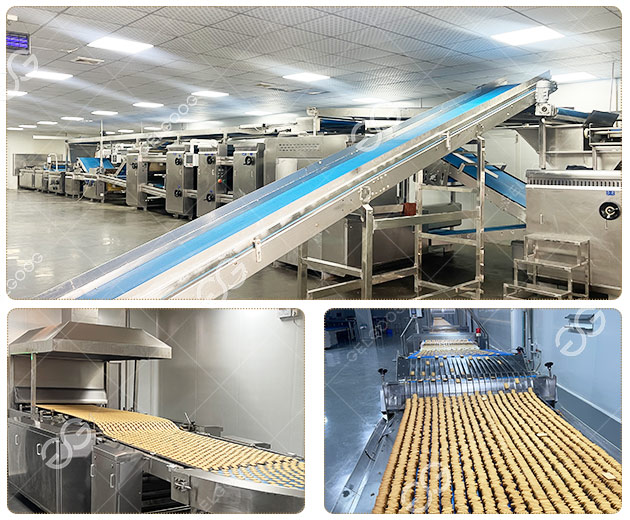
Biscuit Factory Setup: Defining Products and Processes
Before planning the production line, manufacturers should define the target biscuit products, since each variety may require a different processing approach. Hard, soft, sandwich, cream-filled, and molded biscuits can vary considerably in dough consistency, forming requirements, and processing conditions, which directly affects the choice of production equipment.
For instance, hard (tough) biscuits are typically produced using dough sheeting and rotary cutting, whereas short (crisp) biscuits are better suited for rotary molding or wire-cutting. Since the forming method directly dictates the equipment configuration of the production line, it is essential to finalize product specifications, including output volume, biscuit dimensions, thickness, and packaging format before selecting the machinery.
A complete industrial biscuit production line seamlessly integrates stages such as dough mixing, sheeting or forming, baking, cooling, and packaging. This setup enables continuous product flow, minimizes unnecessary manual handling, and enhances overall production efficiency.
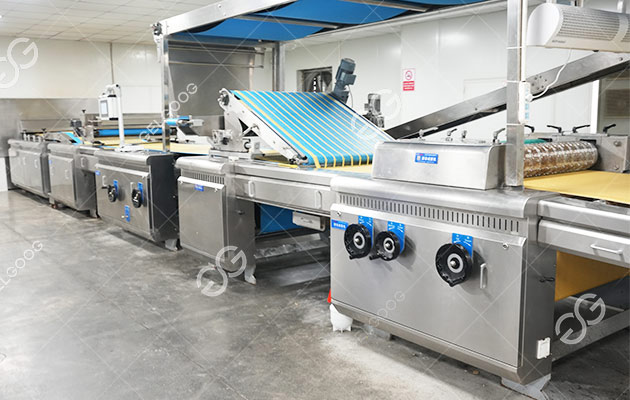
Baking performance determines the final quality of the biscuits.
Baking is a crucial stage in biscuit production. Factors such as baking temperature, duration, heat distribution, and the extent of moisture removal all influence the biscuits’ final color, crispness, internal structure, and shelf stability.
Continuous tunnel ovens allow for the configuration of multiple temperature zones and independent temperature control at various stages, ensuring consistent heat exposure throughout the baking process. Baking parameters can also be adjusted to manage surface color and internal moisture levels for products with varying recipes and thicknesses.
Once baking is complete, the biscuits must be thoroughly cooled before proceeding to the packaging stage. Proper cooling minimizes the risk of condensation forming inside the packaging while preserving the biscuits’ crisp texture. Additionally, the cooling system bridges the oven and downstream packaging equipment, streamlining the overall production workflow.
Creating a Flexible Industrial Biscuit Production Line
An efficient biscuit factory setup should be planned around the factory’s production goals and operating requirements. The line configuration needs to coordinate each processing stage, from dough preparation and shaping to baking, cooling, and final packaging, so that materials can move smoothly between processes and the entire operation remains efficient.
For large-scale biscuit factory projects, production lines can be customized based on target output, biscuit varieties, available floor space, and the desired level of automation. The right equipment configuration enables consistent product quality, continuous production, and higher efficiency, while simultaneously reducing the need for manual labor.